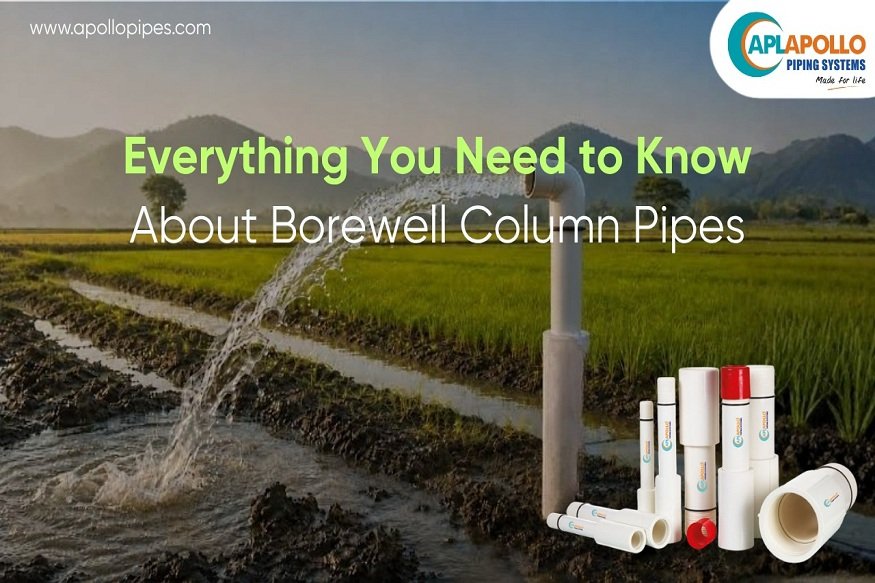

Access to underground water is essential for many farms, homes, and other properties where a reliable water source is required. A borewell system, combined with a submersible pump, provides an efficient way to extract water from below the ground. However, the performance of such a system depends on more than just the pump. The borewell column pipe plays an important role in carrying water from the submerged pump toward the surface while supporting the weight of the complete assembly.
Choosing a strong, durable, and appropriately sized column pipe can help ensure dependable water extraction and smooth borewell operation over time.
What Is a Borewell Column Pipe?
A borewell column pipe is the pipe installed between a submersible pump and the water delivery system above ground. When the pump operates, the column pipe carries extracted underground water upward. At the same time, it supports the weight of the pump, the water contained inside the pipe, and the pipe itself.
Because of this demanding role, a borewell column pipe must have suitable load-bearing strength and reliable connections. It also needs to cope with movement, vibration, and operational loads generated when a submersible pump starts or stops.
Read More:Composite cladding: Better than timber?
Modern uPVC column pipes are increasingly used in borewell applications because they can provide a lightweight alternative to conventional metal piping. Their resistance to corrosion and relatively easy handling can also simplify transportation and installation.
Importance of Borewell Column Pipes in Agricultural Water Systems
Agriculture often depends on a consistent water supply for irrigation, livestock, and other farm activities. In areas where underground water is available, borewells equipped with submersible pumps can provide an important source of water.
The borewell column pipe connects the pump to the surface and forms a critical part of the water extraction system. A suitable pipe should be capable of handling the system load while maintaining secure connections throughout operation.
For agricultural users, lightweight construction can be particularly useful. Borewell pipes that are easier to transport and handle can make installation and maintenance more convenient, especially at farms where equipment and materials may need to be moved across considerable distances.
Resistance to corrosion and chemicals is another important consideration. Unlike metal pipes that may be vulnerable to corrosion in certain environments, suitable plastic column pipes can offer greater resistance to corrosion, helping support long-term use in underground water systems.
Borewell Column Pipe for Domestic Water Systems
Borewells are also used to supply water to homes, residential buildings, and other domestic properties. A properly designed domestic borewell system can provide water for applications such as cleaning, gardening, sanitation, and other household requirements, depending on local water quality and regulations.
For homeowners, choosing the right borewell column pipe is important because the pipe remains inside the borewell and can be difficult to access after installation. Strength, secure connections, leak prevention, and long-term durability should therefore be considered before selecting a product.
Correct installation is equally important. Pipe size should be compatible with the submersible pump and the overall borewell design. Properly tightened couplings and correctly supported pipe sections help reduce the risk of connection problems during operation.
Key Features to Consider When Choosing a Borewell Column Pipe
Selecting borewell pipes should involve more than simply comparing prices. Consider the following factors:
l Material and Construction Quality
Choose a pipe manufactured from a suitable material with consistent construction quality. uPVC column pipes can offer useful characteristics such as corrosion resistance and lightweight handling.
l Tensile Strength and Load-Bearing Capacity
The pipe must support the combined weight of the pump, water, and pipe. Its tensile strength and load-bearing capability should be appropriate for the borewell depth and pump configuration.
l Resistance to Shock and Operational Loads
Submersible pumps can create jerk and shock loads during operation. A suitable thread and coupling design should be capable of handling these forces reliably.
l Chemical and Corrosion Resistance
Underground water conditions can vary considerably. Chemical and corrosion resistance can contribute to longer-lasting borewell installations.
l Coupling and Thread Design
Connections are critical in a column-pipe system. A reliable thread or coupling system helps keep individual pipe sections securely joined.
l Leak-Proof Connections
Secure joints help prevent water leakage and reduce the possibility of connection failure. The coupling system should be selected according to the pipe and installation requirements.
l Handling and Installation
Lightweight pipes can be easier to transport, position, and install than heavier alternatives. This can be particularly useful for agricultural and remote borewell projects.
l Size and Service Life
Pipe diameter should be selected according to the pump, water flow requirements, borewell configuration, and project specifications. Long-term durability should also be considered when evaluating the overall value of a column pipe.
APL Apollo Borewell Column Pipes
APL Apollo’s borewell column pipe range is manufactured using sturdy uPVC and is designed specifically for submersible pump and borewell applications. According to the company’s official product page, the pipes feature a thread design intended to withstand shock and jerk loads during operation. The construction also incorporates technology intended to maintain uniform thickness and provides chemical resistance.
The system is designed to handle the combined load of the pump, water, and pipe. APL Apollo also highlights a super-lock system and leak-proof couplings secured using nylon wire. The pipes are described as lightweight and suitable for handling, transportation, and installation, while the company lists high tensile load capacity among their features.
The official product page lists features including quality raw material, world-class machining, economical operation, chemical resistance, non-conductive properties, longevity, and quality water. The pipes are available in diameters from 33 mm to 168 mm (1 inch to 6 inches), with listed sizes including 33, 42, 48, 60, 75, 88, 113, 140, and 168 mm.
Read More: How Might the Process of Digging and Hauling Be Made Simpler?
APL Apollo states that its uPVC column pipes are commonly used with submersible pumps to bring underground water to the surface, particularly in farms and agricultural applications. The company’s product information also identifies residential and industrial spaces among the applications.
Conclusion
A reliable borewell column pipe is an important component of any submersible pump-based water system. Whether the application is agricultural irrigation or domestic water supply, the pipe needs to support the system load, provide secure connections, and withstand the conditions associated with underground water extraction.
When selecting borewell pipes, consider material quality, tensile strength, coupling design, corrosion resistance, pipe size, installation requirements, and expected service life. Choosing a properly sized and durable column pipe can contribute to a safer, more dependable, and efficient borewell installation.